
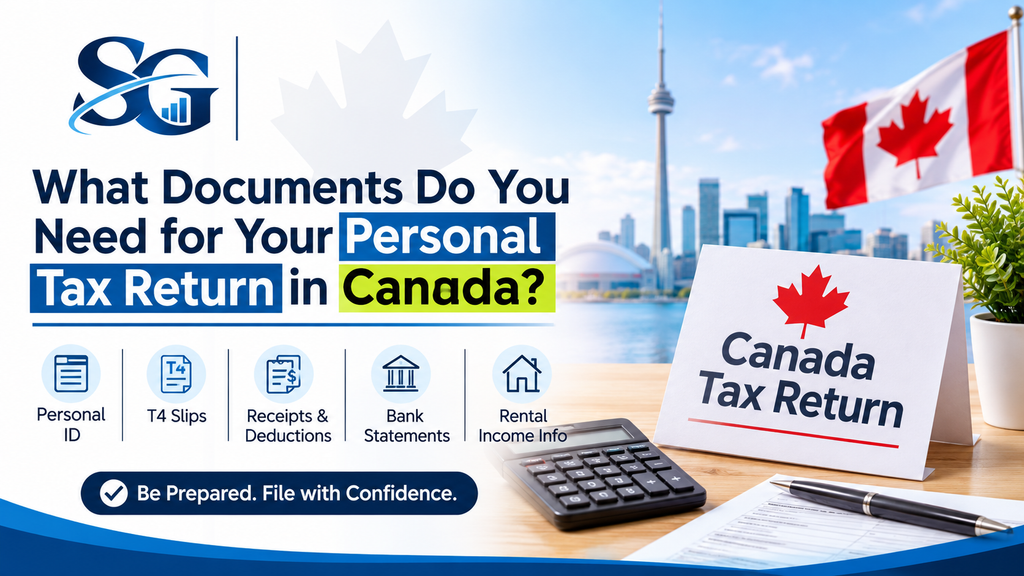
Every year, the same thing slows down a tax return more than anything else: a missing slip or receipt. Getting your documents together before you sit down with your return, or before you meet your accountant, makes the process faster and helps make sure nothing you are entitled to claim is left out.
This guide sets out the documents most individuals in Ontario need for their 2026 personal income tax return, which is filed in 2027. Not every item will apply to you. Use it as a checklist and gather only what matches your situation.
Key dates for your 2026 tax return
- End of February 2027: most information slips (such as T4 and T5 slips) should reach you by this point.
- April 30, 2027: deadline for most individuals to file their 2026 return and pay any balance owing.
- June 15, 2027: filing deadline if you or your spouse or common-law partner were self-employed in 2026. Any balance owing is still due on April 30.
The Canada Revenue Agency announces the date online filing opens each year. Check canada.ca for the current dates before you file, as dates and rules can change.
1. Personal information
Start with the basics. These details are needed for every return:
- Your full name, current address, and date of birth
- Your Social Insurance Number (SIN)
- Your marital status on December 31, 2026, and your spouse’s or common-law partner’s details, including their net income
- Names and dates of birth of any dependents
- Your banking details for direct deposit of refunds and benefit payments
- A copy of last year’s Notice of Assessment
Your Notice of Assessment is worth keeping close. It shows your RRSP deduction limit and any amounts carried forward from earlier years, such as unused tuition amounts.
2. Income slips
Information slips report income that was paid to you during the year. They are issued by employers, banks, pension plans and government programs. Depending on your situation, you may receive:
| Slip | What it reports |
|---|---|
| T4 | Employment income |
| T4A | Pension, retirement, annuity, and other income, including some self-employed commissions |
| T4A(OAS) | Old Age Security |
| T4A(P) | Canada Pension Plan benefits |
| T4E | Employment Insurance benefits |
| T5 | Investment income such as interest and dividends |
| T3 | Trust income, including many mutual fund distributions |
| T5008 | Proceeds from selling securities |
| T4RSP / T4RIF | Withdrawals from an RRSP or RRIF |
| T5007 | Social assistance or workers’ compensation (WSIB) benefits |
If a slip is missing or lost, check your CRA My Account first: many slips are available there. Otherwise, contact the employer or institution that issued it.
3. Income that doesn’t come with a slip
Some income has to be reported even though nobody sends you a slip. Keep your own records for:
- Self-employment or business income: sales, fees, and commissions, plus your business expenses
- Rental income: rent received and the related expenses, such as mortgage interest, property tax, insurance, and repairs
- Capital gains or losses: sale dates, proceeds, and original cost for investments or property you sold
- Foreign income: income earned outside Canada while you were a resident
- Tips and cash income
If you sold a property during the year, keep the purchase and sale documents. A sale of your principal residence still needs to be reported on your return.
4. Receipts for deductions and credits
Deductions and credits can lower the tax you pay, but only if you can support them. Gather receipts for any of these that apply:
- RRSP contributions (including those made in the first 60 days of 2027)
- First Home Savings Account (FHSA) contributions
- Child care expenses, with the provider’s name and details
- Medical expenses for you, your spouse, and dependants
- Charitable donations to registered charities
- Tuition (form T2202 from your school)
- Union and professional dues
- Employment expenses, with Form T2200 signed by your employer if required
- Moving expenses, if you moved for work or full-time studies
- Interest paid on government student loans
- Disability Tax Credit approval (Form T2201), if applicable
- Rent or property tax paid for Ontario credits
- Tax installments paid during the year
5. Extra records for self-employed individuals
If you run a business as a sole proprietor or earn commissions, you will also need:
- A summary of business income and expenses for the year
- Purchase documents for equipment or vehicles
- A vehicle logbook showing total kilometers and business kilometers
- Home office details: the area used for business and the home’s total area, plus utilities, rent or mortgage interest, property tax, and insurance
- HST returns filed during the year, if you are registered
Keep the original receipt for every expense you claim. A spreadsheet or summary on its own is not enough if the CRA reviews your return.
How long should you keep your records?
The CRA recommends keeping your receipts and supporting documents for at least six years after you file, in case it asks to review them. Keep a copy of your return and your Notice of Assessment or Reassessment too: they make next year’s return easier to prepare.
Quick checklist
- Personal details, SIN, and last year’s Notice of Assessment
- All income slips (check CRA My Account for any that are missing)
- Records of income without slips (business, rental, investment sales, foreign income)
- Receipts for deductions and credits
- Business records and a vehicle logbook, if self-employed
- Banking details for direct deposit
FAQs:
1. What documents do I need for my personal tax return in Canada?
You typically need your T4 slips, personal identification, receipts, and records of deductions or other income.
2. Do I need to submit receipts with my tax return?
Usually, you keep receipts as proof of eligible expenses and provide them to the CRA if requested.
3. What if I have multiple T4 slips?
Include income information from all your T4 slips when preparing your tax return.
4. Do self-employed individuals need additional documents?
Yes, they generally need business income records, expense receipts, and supporting financial documents.
5. How long should I keep my tax documents in Canada?
Generally, keep your tax records for at least six years, as required under CRA record-keeping rules.